Identity Shift Protocol
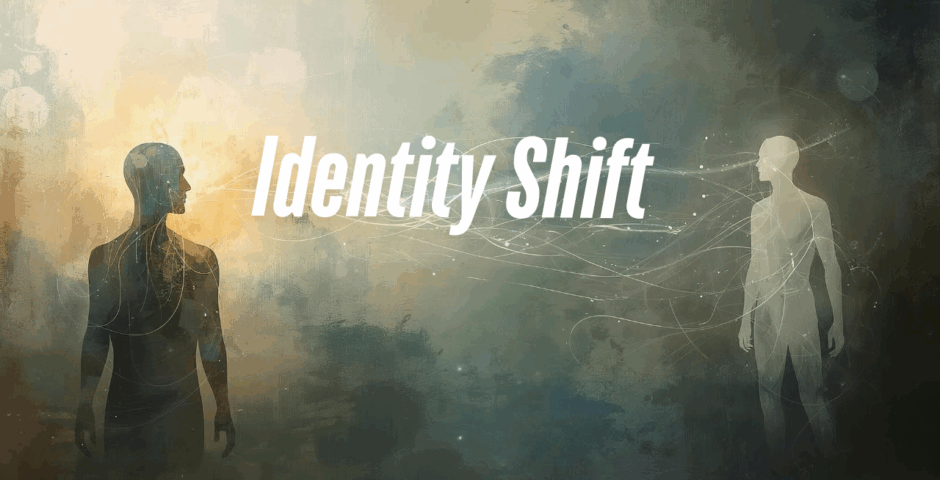
Note. This is a bold protocol that has the potential to completely transition you from your current ‘identity of self’ to a completely new identity, which means a big shift that will most certainly separate you from places, people, habits, likings, etc that no longer serve your new destined identity.
This identity we’re speaking about is of the character you are presently playing in this life.
In awareness, we know the self is the soul. In a consciousness, the identity of the self is with the character.
Let’s explore the idea of the self from a conscious state.
1. The Self (The Psychological and Philosophical Answer)
This is the core identity of the character that encompasses your consciousness, personality, memories, beliefs, and desires. It’s the “you” that persists over this lifetime.
- Key Idea: It’s the integrated totality of who you are. The philosopher René Descartes’ famous line, “I think, therefore I am,” is a foundational statement about the Self.
- How it “controls” everything: Your sense of self governs your decisions, shapes your perceptions, and forms the narrative of your life. It’s the executive centre of your personality.
Other Important Concepts (Parts of the Whole)
While “the Self” is the overarching identity, other concepts describe specific mechanisms through which it controls things:
2. The Unconscious/Subconscious Mind (The Psychoanalytic Answer)
Proposed by Sigmund Freud, this is the part of your mind that contains desires, memories, and instincts you are not actively aware of.
- Key Idea: It’s a vast reservoir of feelings, thoughts, and urges that lie outside your conscious awareness but exert a powerful influence on your behaviour.
- How it “controls” everything: It drives primal instincts (sex, aggression), stores repressed memories, and influences your dreams, slips of the tongue, and irrational fears.
3. The Ego (A Specific Part of the Self in Psychoanalysis)
In Freudian theory, the ego is the conscious part of the self that mediates between the irrational desires of the id (the primal self) and the moralistic demands of the super-ego (the conscience).
- Key Idea: It’s the “manager” of your personality, operating on the reality principle.
- How it “controls” everything: It makes executive decisions, delays gratification, and tries to find realistic ways to satisfy your needs without getting you into trouble.
4. The Brain (The Biological Answer)
From a strictly scientific perspective, the organ that controls everything about you is your brain.
- Key Idea: Every thought, emotion, memory, and decision is the result of complex electrochemical activity in your neural networks.
- How it “controls” everything: It processes sensory input, regulates bodily functions, and generates consciousness itself. Your “Self” is an emergent property of your brain’s activity.
5. The Soul or Spirit (The Spiritual/Religious Answer)
In many traditions, this is the eternal, non-physical essence of a person.
- Key Idea: It is the true, immortal identity that exists before and after the body. It is the source of absolute awareness and higher consciousness.
- How it “controls” everything: It guides your moral compass, connects you to a divine source, and is the ultimate seat of your will and intention.
Can we change our identity?
The idea that changing your identity can change your reality is a powerful and well-supported concept across psychology, philosophy, and personal development.
It’s not a magical process, but a practical and psychological one. Your identity acts as a filter and a director for your life.
Here’s how it works and why it’s so effective:
1. Identity Shapes Your Perception (Your Internal Reality)
Your identity is a lens through which you see the world. If you identify as a “victim,” you will perceive threats and injustices everywhere. If you identify as a “learner,” you will see challenges as opportunities to grow.
- Example: Two people get laid off from their job.
- Person A (Identity: “I’m a failure”): Perceives this as confirmation of their inadequacy. Their reality becomes one of despair and hopelessness.
- Person B (Identity: “I’m a resilient professional exploring new opportunities”): Perceives this as a difficult but necessary step toward a better career. Their reality becomes one of networking, learning, and excitement for the future.
- Person A (Identity: “I’m a failure”): Perceives this as confirmation of their inadequacy. Their reality becomes one of despair and hopelessness.
The same event, two completely different realities, all based on identity.
2. Identity Dictates Your Actions (Which Shape Your External Reality)
Your actions are consistent with your identity. You behave in ways that prove to yourself who you believe you are. This is one of the most direct ways identity creates reality.
- The Classic Example: The Smoker
- If someone who smokes is offered a cigarette, they might say, “No thanks, I’m trying to quit.” The action (struggling to quit) is in conflict with the identity (“a smoker”).
- If someone who is a non-smoker is offered a cigarette, they simply say, “No, thanks.” The action is effortless because it aligns with their identity.
- If someone who smokes is offered a cigarette, they might say, “No thanks, I’m trying to quit.” The action (struggling to quit) is in conflict with the identity (“a smoker”).
- Changing the Identity: The key to quitting smoking isn’t just white-knuckling through cravings. It’s to first become a non-smoker in your mind. Once you see yourself as a person who doesn’t smoke, the actions follow naturally.
3. The Self-Fulfilling Prophecy Loop
This is the engine of the process. Your beliefs about yourself (identity) lead to actions that produce results that reinforce the original belief.
Negative Loop:
“I’m bad with money” (Identity) → Spends impulsively, avoids budgets (Action) → Accrues debt (Reality) → “See? I told you I was bad with money.” (Reinforcement)
Positive Loop (After Change):
“I am good with managing my finances” (New Identity) → Creates a budget, saves automatically (Action) → Savings grow, debt shrinks (New Reality) → “I really am good at this.” (Reinforcement)
How to Actually Change Your Identity
This isn’t about positive affirmations you don’t believe. It’s a process of “acting as if” until evidence accumulates.
Decide Who You Want to Be: Be specific. Not “I want to be rich,” but “I am the kind of person who builds wealth through discipline and smart investments.” Not “I want to be fit,” but “I am an active and healthy person.” Think of, and cover every area of your life. On paper, create a complete new identity. This will be your new you.
Act Like That Person: This is the most crucial step. Start with small, consistent actions that your “new self” would take.
- The “Healthy Person” doesn’t just go to the gym once; they take the stairs, they meal prep on Sundays, they choose water over soda.
- The “Writer” doesn’t just wait for inspiration; they write 200 words every morning.
Rewire Your Internal Dialogue: Catch yourself when you use old identity language. Change “I’m trying to eat healthy” to “I eat healthy.” Change “I wish I could be more confident” to “I am becoming more confident every day.”
Surround Yourself with Evidence: Your brain needs proof. Keep a journal of your new actions. Did you go for a run? That’s evidence you’re an active person. Did you save money? That’s evidence you’re financially savvy. This evidence solidifies the new identity.
This protocol will facilitate the change to the new identity. The shift will occur in your consciousness, which will then cause the shift in all other areas of your life. This way, you can bypass the limitations that exist in the present identity.
Please note, this is a protocol for the more advanced energy worker. It places a lot of power in your hands to create dramatic changes in your life. So, put a lot of thought into what you’re doing and why you’re doing it.
The Youtube version will facilitate the changes to your identity that you desire.
The advanced version is a powerful conscious program, which will not only facilitate the change from present identity to desired identity, but one you can consult with for guidance throughout the process. You can speak with it during the planning process, speak with it about how the changes will manifest, etc.
Once again, it’s more advanced level energy work. Please think carefully about your desired identity before you begin making any changes.
Once you have decided, play the protocol 2 – 3 times a day, reading over what you’ve written about your new identity, and ask the energy field to establish the new identity. Following the guidance on 4 points above will help fast track the transformation.

You May Also Like