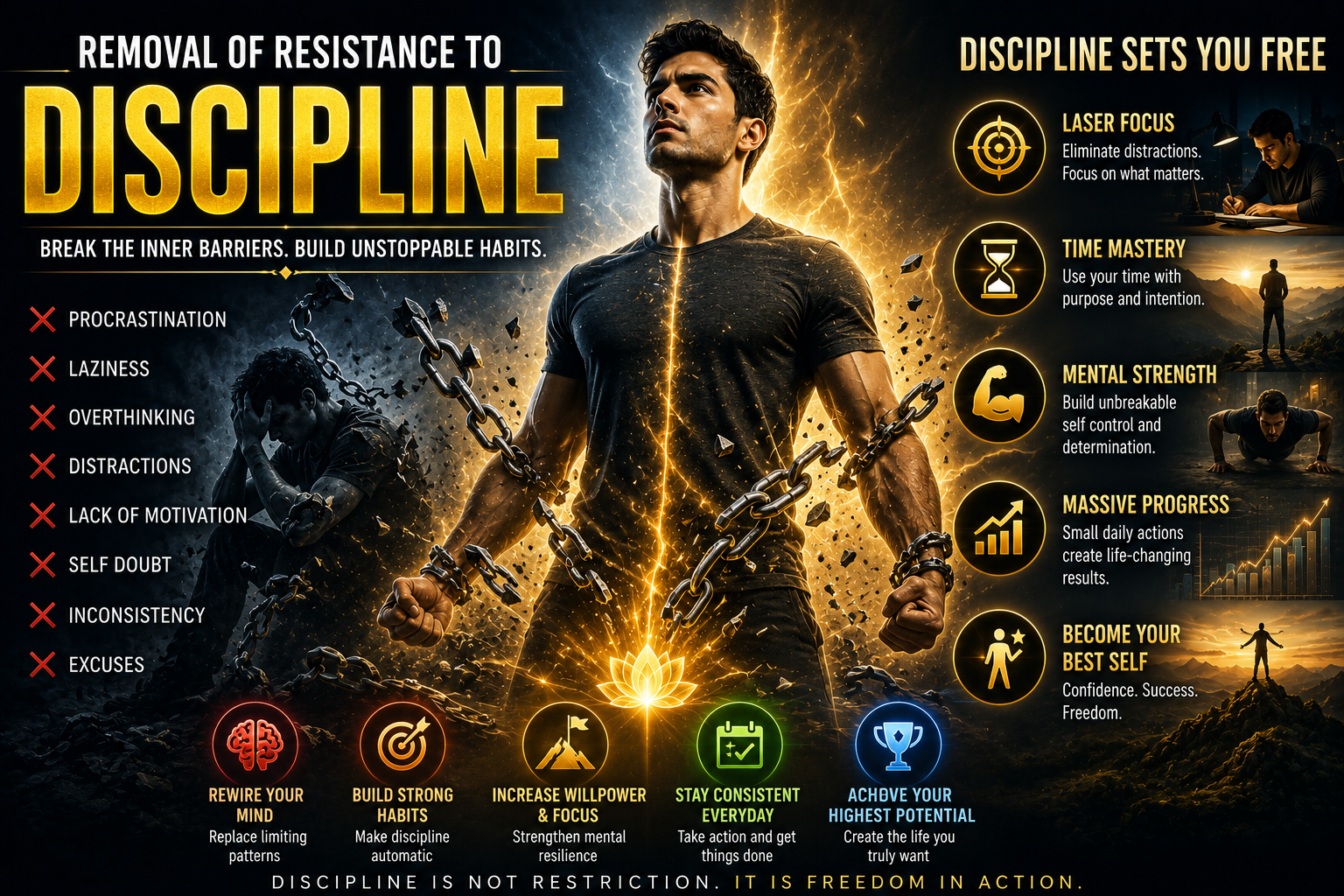
Dissolve Resistance To Discipline
A lack of discipline often times can be diagnosed as laziness, but discipline is usually the result of several psychological, biological, emotional, and environmental factors working together.
A person can genuinely want something and still repeatedly fail to act on it.
Some of the most common reasons for a lack of discipline are:
Preference for immediate gratification — the brain naturally gives more weight to rewards available now than rewards that may arrive weeks or months later. Watching a video feels good now; getting fit requires months of effort.
Weak connection to the goal — people are much more consistent when a goal has emotional meaning. “I should exercise” is weaker than having a deeply felt reason to become healthy.
No clear structure — vague intentions such as “I’ll start exercising” require repeated decisions. “I train at 7 a.m. Monday, Wednesday and Friday” removes much of that decision-making.
Habitual comfort seeking — repeatedly choosing the easier option reinforces the tendency to avoid discomfort. Eventually even relatively small amounts of effort can feel disproportionately unpleasant.
Low tolerance for discomfort — discipline frequently means acting while bored, tired, frustrated, uncertain, embarrassed or unmotivated. Some people aren’t lacking ambition so much as they haven’t developed the ability to remain with discomfort.
Dependence on motivation — motivation fluctuates. Someone may work intensely when inspired and stop when the feeling disappears. Discipline develops when behaviour becomes less dependent upon mood.
Overwhelming goals — “lose 25 kg,” “write a book,” or “build a successful business” can feel enormous. The brain sees the distance between the present situation and the desired outcome and avoidance follows.
Perfectionism — surprisingly, perfectionism can destroy discipline. If someone believes something must be done perfectly, beginning becomes psychologically expensive. Missing one day can also become “I’ve ruined everything.”
Fear of failure — avoiding action protects a person from discovering whether they can actually succeed. Procrastination can therefore function as emotional protection.
Fear of success or change — achieving something can introduce responsibility, visibility, expectations or changes in identity. A person may consciously want the result while unconsciously resisting what comes with it.
Low self-efficacy — repeated failures can create the expectation, “I’ll probably give up again.” Once someone stops believing their actions will produce meaningful results, persistence declines.
Negative self-identity — statements such as “I’m lazy,” “I have no willpower,” “nothing ever works” or “I never finish anything” can become self-reinforcing narratives. Behaviour gradually conforms to identity.
Emotional avoidance — procrastination is often about regulating emotions rather than managing time. A task might trigger anxiety, inadequacy, frustration or uncertainty, so avoiding the task temporarily removes the unpleasant emotion.
Decision fatigue — having to constantly decide what to do, when to do it and how to do it consumes mental resources. Good routines reduce the number of decisions required.
Constant stimulation — phones, social media, gaming, short-form videos and other highly stimulating activities provide effortless rewards. Slower activities such as studying, exercising or building a business can consequently feel comparatively unrewarding.
Poor sleep and physical exhaustion — self-control becomes considerably harder when someone is chronically tired. Sometimes what appears to be a character problem is simply insufficient physical and cognitive energy.
Stress and cognitive overload — financial worries, relationship problems, excessive workloads and other persistent stressors consume attention. There is less mental capacity left for deliberate behaviour.
Mental or neurological factors — depression, anxiety, ADHD and other conditions can interfere with initiation, attention, planning and persistence. In those situations, telling someone simply to “be more disciplined” can miss the underlying issue.
Environment working against the goal — keeping junk food beside you while trying to diet, having notifications constantly appearing while trying to work, or spending time around people who discourage your ambitions creates unnecessary resistance.
Lack of accountability or consequences — when nothing happens if a person postpones something, postponement becomes easy. External deadlines often suddenly produce discipline that seemed absent before.
Too many goals simultaneously — trying to transform fitness, finances, relationships, diet, sleep and career at once spreads behavioural energy too thinly.
Failure to experience progress — the brain responds strongly to evidence that effort is working. When progress isn’t visible, people can lose the reinforcement necessary to continue.
All-or-nothing thinking — “If I can’t exercise for an hour, there’s no point exercising.” Disciplined people often succeed because they permit themselves to do the smaller version rather than nothing.
Not practising discipline itself — discipline can be developed through repeated behaviour. Someone who has spent years immediately responding to impulses hasn’t had much opportunity to strengthen the opposite pattern: I feel an impulse, but I don’t have to obey it.
Here are the stages to consider in any action:
It starts with a desire, followed by resistance, then a decision is made, actual action is taken, repetition occurs, then a new identity is formed.
Someone lacking discipline often concentrates on the action stage only. But the actual problem may exist much earlier in their desire, emotional resistance, in their environment, beliefs or decision-making stage.
In this dissolve resistance to discipline protocol, we’re incorporating 29 subtle energy fields to target and dissolve all resistance to discipline, with particular emphasis on procrastination, comfort dependence, impulsivity, fear of discomfort, perfectionism, overwhelm, negative self-beliefs, emotional avoidance and dependence on motivation. This will cover all issues to discipline before you get to the action stage.
The advanced version maximises the impact of the above with the highest vibration of those energy fields, plus, an additional 21 subtle energy fields that reinforce self control, persistence, delayed gratification, focus, consistency, discomfort tolerance, goal-directed behaviour and identity-based habits.
This removes the forces producing avoidance, whilst also strengthening the capacities that produce consistent action.
So, the Youtube version works on just the resistance prior to the action stage, whilst the advanced version works on both the prior part, and also the action part. What you need to do is to utilise this energy to maintain repetition till it becomes a part of your identity.
As with all dissolve resistance protocols, we’ve used the advanced version to create a list of statements that we encourage you to recite whilst the file plays. We’ve broken the statements down into two groups. The first is the dissolve resistance part, and the second is to enhance discipline.
We recommend consciously listening to the protocol whilst reading the statements below. Do this for a minimum of 40 days.
Dissolving Resistance to Discipline
- I release all resistance to taking consistent action.
- I release the need to avoid tasks that require effort.
- I let go of procrastination and unnecessary delay.
- I release my attachment to comfort when it prevents my growth.
- I dissolve the habit of waiting until I feel motivated before taking action.
- I release resistance to doing what needs to be done.
- I let go of excuses that prevent me from moving forward.
- I release the tendency to abandon tasks when they become difficult.
- I dissolve resistance to routines that support my growth and wellbeing.
- I release the need for immediate gratification when it conflicts with my long-term goals.
- I let go of the belief that discipline is difficult, restrictive or unpleasant.
- I release fear of discomfort, effort and temporary sacrifice.
- I dissolve perfectionism that prevents me from beginning or continuing.
- I release overwhelm by allowing myself to focus on one step at a time.
- I let go of self-sabotaging behaviours that interfere with consistency.
- I release unconscious resistance to commitment and responsibility.
- I dissolve the habit of allowing temporary emotions to control my actions.
- I release negative beliefs about my ability to remain disciplined.
- I let go of past failures and the expectation that I will repeat them.
- I release everything within me that resists consistent, constructive action.
Enhancing Discipline
- I naturally take action on the things that matter to me.
- I am becoming increasingly disciplined in every area of my life.
- I follow through on the commitments I make to myself.
- I take constructive action whether I feel motivated or not.
- I remain consistent even when results are not immediately visible.
- I easily prioritise long-term rewards over temporary gratification.
- I possess strong self-control over my impulses and behaviours.
- I remain focused on my goals despite distractions.
- I complete what I begin.
- I willingly do difficult things that contribute to my growth.
- I become stronger and more disciplined through consistent action.
- I maintain productive routines with increasing ease.
- I calmly continue when I encounter discomfort, boredom or resistance.
- I direct my attention and energy toward what truly matters.
- I keep the promises I make to myself.
- I take responsibility for my choices, actions and results.
- I return to productive action quickly whenever I become distracted.
- Consistency is becoming a natural part of who I am.
- My actions increasingly align with my intentions and long-term goals.
- Discipline is a natural expression of my strength, focus and self-mastery.

You May Also Like